


Best Standing Desks for Small Spaces & Apartments
Key Takeaways
-
Recommend 40”–48” wide electric standing desks as the sweet spot for most small apartments, balancing usable space and compact footprint.
-
Highlight three main types for tight spaces: narrow electric desks, wall-mounted / fold-down standing desks, and foldable / rolling models you can store away.
-
Explain how to measure your nook or corner (including doorways, baseboards, and radiators) before buying so the desk actually fits.
-
Emphasize features that matter most in small homes: cable management, built-in drawers, quiet motors, and wheels or foldability for flexible layouts.
-
Clarify how to set correct sit–stand heights and how often to switch positions to get ergonomic benefits even in a tiny workspace.
Why Standing Desks Matter in Small Apartments
If you work from home in a 450–650 square foot studio or one-bedroom apartment, you already know the challenge. Every piece of furniture needs to earn its place. A traditional desk takes up permanent real estate, often blocking walkways or making your living room feel cramped. Add a separate office chair and filing cabinet, and suddenly your cozy apartment feels like a storage unit.
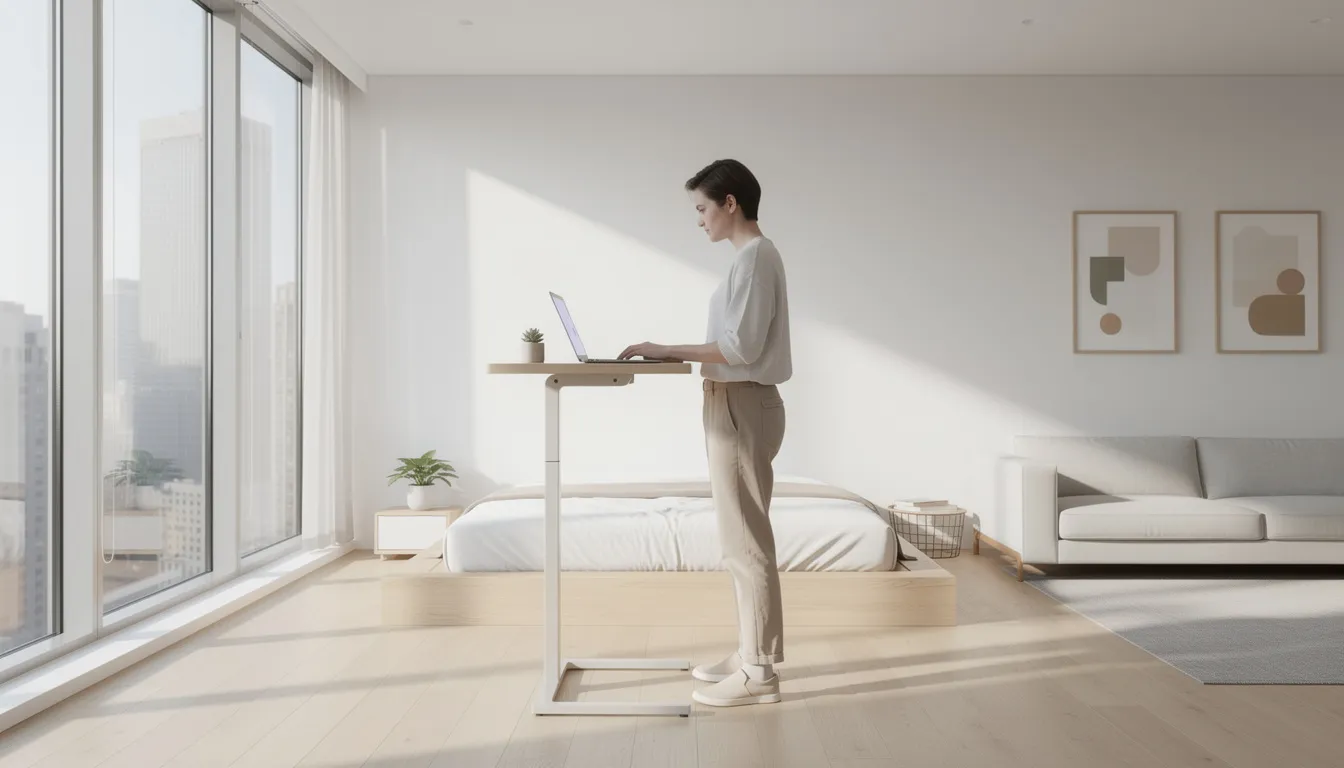
A height adjustable standing desk changes this equation entirely. Instead of dedicating an entire room to your workstation, you can turn a corner of your living room, a nook by the balcony door, or the foot of your bed into a proper office. When the workday ends, you can lower the desk to dining height, roll it aside, or simply appreciate that it takes up no more space than a console table. The best standing desks for small spaces are designed with exactly this flexibility in mind.
Beyond the space savings, there are real health benefits to alternating between sitting and standing throughout your workday. Reduced back and neck pain, improved posture, and increased movement all come with regular position changes. Studies from Cornell University found that workers using sit stand desks reported 15–30% less back pain compared to those at fixed-height desks. In a tiny apartment where you might otherwise spend eight hours hunched over a kitchen table, these gains matter.
Consider practical examples: a 48” electric standing desk tucked behind a sofa, serving as both workspace and room divider. Or a 40” wall-mounted desk in an alcove by a balcony door that folds flat when guests arrive. These setups prove that even in constrained square footage, a dedicated workspace is possible.
The rest of this article is specifically optimized for readers with limited square footage—not those with sprawling home offices. If you’re working with small spaces and need a desk that delivers on productivity without dominating your room, keep reading.
How to Measure Your Space Before You Buy
Before you purchase your first desk, grab a tape measure. The most common mistake small-apartment dwellers make is buying a desk that looks compact online but dominates 10% of their floor space in reality. A few minutes of measuring now saves headaches and return shipping fees later.
Start by measuring the available width and depth in your target spot. Write down both inches and centimetres if your apartment was built with metric dimensions. Don’t just measure the wall—account for the chair behind the desk. You’ll need at least 30 inches (76 cm) of clearance between the back of your chair and any furniture or wall behind you. This gives you room to sit, stand, and move without bumping into your bed frame or sofa.
Next, identify your small-space constraints. Baseboard heaters are notorious for blocking desk placement in older apartments. Radiators can add 4–6 inches of unusable depth along a wall. Low windowsills might limit your standing height if you want natural light. Closet doors that swing outward need clearance, and power outlet placement determines where you can actually plug in an electric standing desk without running cords across walkways.
If you live in a walk-up or older building, check your doorway width. Standard interior doors range from 28–32 inches wide. A fully assembled desk with a 48” top won’t fit through a 30” door. You’ll either need a desk that ships flat-packed or one designed to be assembled inside the room.
For most small apartments, target desktop sizes between 40–48 inches wide and 24–30 inches deep. Choose 24” depth if the desk must sit against a wall in a tight corner or share space with a bed. Go with 30” depth if you need room for multiple monitors or frequently spread out paperwork. These dimensions provide enough workspace without overwhelming a 500-square-foot apartment.
Finally, think vertically. If floor space is limited, wall shelves above your desk can replace a deeper desktop for storing books, supplies, or a second monitor on an arm. A pegboard system behind the desk keeps tools visible and accessible without adding drawers that push the desk further into the room. Measure your ceiling height and any existing shelving to ensure your standing height won’t put your head in the way of overhead storage.
Types of Standing Desks That Work Best in Small Spaces
Not all standing desks are created equal, and some designs work dramatically better in apartments than others. Understanding your options helps you match your desk to your specific living situation, whether that’s a studio where every inch counts or a one-bedroom where you can dedicate a corner to work.
Compact electric sit–stand desks are the most popular choice for apartment dwellers. Models in the 40–48” width range feature narrow frames that tuck into corners or slide beside a sofa without blocking traffic. Most offer a height range of approximately 28–47 inches, accommodate most people from 5’0” to 6’4”, and use dual motors for stable lifting. The Kinetic from workspace48, for example, offers a 48x24-inch laminate top with a 270-pound weight capacity and anti-collision sensors—all in a footprint that fits comfortably in a 500-square-foot studio. Electric models typically adjust at 1.5–2.5 inches per second, making position changes quick and effortless.
Wall-mounted and fold-down standing desks maximize floor space in the smallest apartments. Units bolt directly to wall studs and fold flat against the wall when not in use, projecting just 4–6 inches when stored. These desks free up the entire floor area underneath them, making studios feel significantly larger. The trade-off is a lower weight limit (typically 100–150 pounds) and the requirement for proper wall mounting—not ideal for renters who can’t drill into studs.
Foldable and rolling standing desks offer maximum flexibility for people who need to reconfigure their space regularly. Models with locking casters can roll from a wall to a window during the day, then tuck into a closet after work hours. Collapsible frame desks fold down to just a few inches thick for storage behind a sofa or in a coat closet. If your apartment doubles as an Airbnb on weekends or you frequently host guests, this category deserves serious consideration.
Standing desk converters transform existing furniture into sit–stand workstations without requiring a dedicated desk purchase. If you already have a 30–36” console table or narrow dining table, a converter adds 12–20 inches of height adjustment while maintaining your existing setup. Converters typically weigh 15–30 pounds, making them easy to move, and many models measure under 36x24 inches—perfect for tables that can’t accommodate a full-size desk. This approach makes sense when you’re testing whether a sit stand desk works for your lifestyle before investing in a dedicated unit.
Ultra-narrow models designed for hallway corners or balcony workspaces push depth down to 20–24 inches. These slim designs sacrifice some surface area but fit in spaces where nothing else works. Keep stability considerations in mind with these desks—narrower bases can wobble at standing height if the frame design isn’t robust. Look for desks with wide, stable standing desk frame construction and consider weight distribution when loading them with equipment.
Best Standing Desk Setups for Small Apartments
Your ideal standing desk setup depends entirely on your apartment layout. A configuration that works perfectly in a one-bedroom won’t necessarily fit a studio, and shared living spaces require different considerations than private bedrooms.
For studios under 500 square feet, a 40–48” electric desk placed at the foot of your bed or along a window wall often works best. This positioning keeps the desk away from your sleeping area visually while maximizing natural light for video calls. Skip deep storage units that eat floor space. Instead, use shallow drawers underneath the desktop and floating wall shelves above for books and supplies. A 48x24” desk like the Kinetic provides adequate workspace for a laptop, external monitor, and accessories without dominating the room. Consider light-colored desktop materials like white or birch to maintain an open, airy feel.
For one-bedroom apartments, you have more options. A 48x24” or 48x30” adjustable standing desk against a bedroom wall creates a dedicated workspace separate from your living and relaxation areas. The key is choosing a compact task chair that slides fully under the desk when you’re standing or away. This detail alone can save 18–24 inches of floor space that would otherwise be lost to a protruding chair. If noise is a concern for roommates or partners, placing the desk in the bedroom rather than the living room keeps video calls and typing sounds contained.
For shared living rooms, consider using a slim standing desk as a sofa “console” workstation. Positioned behind your couch, the desk becomes invisible from the seating area while providing a complete office when you stand. Alternatively, float a 40” desk perpendicular to a wall to define a micro-office zone without building actual walls. This approach works particularly well in long, narrow apartments common in urban high-rises.
Corner and L-shaped sit–stand desks can work in larger small apartments—think 700+ square feet with dedicated nooks. The Switchback L-shaped variant at 48x48 inches fits corner spaces that would otherwise go unused. However, for very small apartments, a straight compact desk almost always proves more versatile than an L-shape that commits you to a single corner forever.
When choosing your location, focus on where natural light, noise levels, and power outlets align. The perfect desk in the wrong spot leads to frustration. A beautiful window-facing position loses appeal if the nearest outlet requires a 15-foot extension cord across your walking path.

Features That Matter Most in a Small-Space Standing Desk
When floor space comes at a premium, the details matter more than ever. Features that seem like nice extras in a large office become essential in tight quarters. Focus your budget on the capabilities that directly address small-space challenges.
Quiet motors matter significantly in thin-walled condos and shared apartments. The best electric standing desk models operate at decibel levels comparable to a quiet conversation—around 40–50 dB during adjustment. Budget standing desk options with single motors can be noticeably louder and more prone to vibration that travels through floors. If you share walls with neighbors or work while a partner sleeps in the next room, prioritize motor noise specifications from standing desk manufacturers.
Cable management prevents your compact workspace from becoming a tangled mess. In small apartments, desk cords are visible from multiple angles. Look for under-desk trays, built-in grommets, and integrated power strips. These features route cables cleanly and keep them from snaking across your living room floor. A desk with a dedicated control paddle and USB A ports built into the surface reduces the number of adapters cluttering your limited desktop real estate.
Storage solutions replace bulky furniture in small homes. Shallow drawers underneath the desktop hold pens, notebooks, and accessories without adding visual bulk. Integrated shelves or rail systems provide vertical storage that works with, not against, limited square footage. Skip the filing cabinet—a desk with even modest built-in storage often provides enough room for essential paperwork.
Controls and programmable height settings prove invaluable when your desk serves multiple functions. If the surface doubles as a dining table or vanity, memory presets let you return instantly to your correct sitting and standing height without guessing. Most quality desks offer 3–4 preset positions, allowing different users or uses to be saved and recalled with a single button press.
Wheels and portability matter if your desk must move regularly. Locking casters allow the desk to roll from wall to window during the day, then tuck away for weekend entertaining. Even if you don’t move the desk daily, wheels make reconfiguring your apartment significantly easier. Just ensure the casters lock solidly—an unstable standing desk at 44” height is a safety hazard.
Desktop materials and finishes affect how your desk integrates visually. Lighter colours like white, birch, and light oak make compact spaces feel larger and more open. Rounded corners reduce the visual weight of the furniture and protect shins in tight walkways. The build quality of the desktop surface matters too—bamboo and quality laminate resist coffee rings and laptop heat better than cheaper materials that show wear quickly.
Ergonomics in Tight Quarters: Getting Height and Posture Right
A standing desk only delivers health benefits if you use it correctly. Even in the smallest apartment, proper ergonomic setup prevents the neck pain, shoulder tension, and leg fatigue that send people back to their old desks within weeks.
Setting the correct sitting and standing height is simpler than it sounds. At both positions, your goal is the same: elbows bent at roughly 90–110 degrees, wrists flat or slightly angled downward, and shoulders relaxed rather than hunched. Your desired height will vary based on your body, but the principle remains constant regardless of whether your desk is 40” or 60” wide.
For concrete reference, here are typical standing height ranges based on user height:
|
Your Height |
Approximate Standing Desk Height |
|---|---|
|
5’4” (163 cm) |
40”–42” (102–107 cm) |
|
5’8” (173 cm) |
42”–44” (107–112 cm) |
|
6’0” (183 cm) |
44”–46” (112–117 cm) |
|
6’4” (193 cm) |
46”–48” (117–122 cm) |
Monitor placement requires attention in small spaces where depth is limited. Position the top of your screen at or slightly below eye level, about an arm’s length away. A single monitor arm saves 4–6 inches of depth compared to the monitor’s original stand, which can make the difference between a cramped and comfortable setup. If you use multiple monitors, consider a stacked vertical arrangement rather than side-by-side to minimize width requirements.
The key to ergonomic success is movement. Experts recommend alternating between sitting and standing every 30–60 minutes. Don’t stand for four hours straight—this causes leg fatigue and can actually increase discomfort compared to sitting. Even in a tiny apartment, short walks to the kitchen or balcony every hour help circulation and protect against the muscle stiffness that comes from any static position.
Small-space accessories extend your ergonomic options. A foldable anti-fatigue mat slides under the sofa when not in use, providing standing comfort without permanent floor clutter. A compact footrest like a small stool lets you shift weight and rest one leg periodically. If desk depth limits your keyboard placement, a slim keyboard tray mounted underneath the desktop can reclaim working space while keeping your arms at the correct angle.

Saving Money and Space: Alternatives to Full Standing Desks
Not everyone can fit or afford a dedicated electric sit stand desk. If your apartment is exceptionally small or your budget is tight, several alternatives deliver many of the same benefits with smaller footprints and lower price points.
Standing desk converters placed on existing furniture offer the lowest barrier to entry. If you already own a narrow console table, dining table, or even a sturdy dresser, a converter adds 12–20 inches of height adjustment without requiring a new desk purchase. Models like the VariDesk Pro Plus 36 work on surfaces as small as 24” deep, though stability improves with deeper bases. Converters range from $150–$400 compared to $200–$800 for full electric standing desks—a significant savings for the budget-conscious.
Laptop risers with external keyboards transform any surface into a temporary standing workstation. A simple adjustable laptop stand on a kitchen counter or high bookshelf lets you work standing without any furniture purchase. Add an external keyboard and mouse, and you have a functional standing setup that disappears entirely after work hours. This approach works especially well if you work from home only 1–2 days per week and don’t need a permanent desk.
Foldable rolling carts serve as mobile standing desks that store away completely. Hospital-style overbed tables and craft carts with height adjustment roll beside a sofa during work, then return to a closet at night. These typically cost $50–$150 and support lighter loads like laptops and single monitors. They lack the polish of other desks from standing desk manufacturers, but they solve the space problem completely.
The trade-offs versus full desks are real. Converters offer reduced stability compared to integrated bases, especially at full standing height. Limited depth makes dual-monitor setups challenging. Cable management options are minimal since converters sit on top of other furniture rather than providing integrated solutions. Lifting a converter onto and off a table daily gets old quickly.
Consider how often you work from home when making this decision. If you’re at your desk eight hours daily, five days a week, the investment in a proper adjustable standing desk pays dividends in comfort and productivity. If you work remotely only occasionally, a converter or laptop riser handles the job without permanent furniture commitment.
Care, Maintenance, and Longevity in a Small Home
A quality small-space standing desk should last 5–10 years with proper care—potentially longer if you select a model with excellent build quality. In high-use home offices where the desk serves as both workspace and dining surface, basic maintenance extends its lifespan significantly.
Protect your desktop surface from daily wear. Use coasters for beverages and a desk pad or felt mat under your keyboard and mouse. Coffee spills and heat from laptop bottoms can damage bamboo, laminate, and veneer surfaces over time. In small apartments where the desk might hold dinner plates one hour and design files the next, these protections become essential rather than optional.
Tighten frame screws periodically, especially if the desk moves often or rolls between rooms. The repeated stress of lifting and lowering, combined with vibration from moving the desk, can loosen connections over time. A quick check every few months prevents wobbling that makes the desk feel cheap and unstable. Most desks include the hex key or Allen wrench needed for adjustments in the original box.
Clean surfaces properly using methods appropriate for apartment living. A microfiber cloth with mild soap handles most cleaning needs. Avoid harsh chemicals like ammonia-based glass cleaners or abrasive scrubbing pads—these can damage laminate finishes and strip protective coatings from wood surfaces. For stubborn marks, a small amount of isopropyl alcohol on a soft cloth usually works without causing damage.
Route cables thoughtfully if you reposition your desk frequently. Cords pinched in doorways or caught under rolling casters fray and fail. Use cable clips to keep wires secured to the desk frame rather than trailing along the floor. Velcro straps bundled underneath the desktop keep power and data cables organized during moves.
Consider warranty coverage when selecting your desk. Better small-space models often carry a long warranty—5 to 15 years on the frame, 2–5 years on motors and electronics. When your desk functions as both office and dining surface, enduring heavy daily use, that warranty provides meaningful protection. The extra features and support from established brands often justify their higher price point over budget alternatives with minimal coverage.
Ready to build a workspace that actually fits your apartment?
Explore our collection of standing desks designed for small spaces—compact 40”–48” tops, smooth electric height adjustment, and clean setups with smart cable management and storage options. Whether you need a slim desk for a corner nook, a rolling option you can move room-to-room, or a setup that keeps your space feeling open, we’ve got apartment-friendly choices that make it easy to work comfortably every day.
Shop our standing desks now and find the right size, finish, and features for your home—so you can sit, stand, and stay productive without sacrificing your floor space.
FAQ
What size standing desk is best for a small apartment?
For studios and one-bedroom apartments, a desktop measuring 40”–48” wide and 24”–30” deep offers the best balance of usable workspace and compact footprint. This size accommodates a monitor, laptop, and essential accessories without dominating your living space. Choose closer to 40” width if the desk must share space with a bed or sit behind a sofa. Go up to 48” if you have a free wall and need room for multiple monitors or spread-out projects. Depth matters too—24” works for laptop-focused setups, while 30” provides breathing room for larger displays.
Can a standing desk really fit in a studio apartment without looking cluttered?
Absolutely. The key is strategic choices: light finishes like white or birch reduce visual weight, slim frames avoid that bulky furniture look, and proper cable management eliminates cord chaos. Position the desk by a window where natural light makes it feel intentional, or use it as a sofa console that disappears from your main sightlines. Replace what would be a deep bookcase with floating shelves above the desk, maintaining an open feel even in 400–500 square foot studios. Many Herman Miller and other models from premium manufacturers specifically design for visual lightness in compact spaces.
Is an electric standing desk too loud for shared walls or roommates?
Quality electric desks operate at noise levels comparable to a quiet conversation—around 40–50 decibels during height adjustment. The adjustment takes only 5–15 seconds, so even if there’s some sound, it’s brief and infrequent. This is unlikely to disturb neighbors in condos or roommates in shared apartments, especially during normal waking hours. If noise is a major concern, look for manufacturer decibel ratings and test adjustments at different times of day. Single-motor budget options tend to be louder than dual-motor models, so factor this into your purchase decision.
Do I need a separate chair if my apartment is very small?
A compact ergonomic chair that slides fully under the desk when not in use is worth the investment for daily work-from-home setups. Dining chairs and stools lack the lumbar support and adjustability needed for 8-hour workdays. Many small-apartment residents successfully share a single good chair between their desk and dining table, rolling it between zones as needed. This approach provides proper ergonomic support without doubling your seating furniture. Look for chairs with slim profiles and armrests that don’t prevent full under-desk storage.
Can I use a standing desk as a dining table or vanity in a small space?
Many people in small apartments successfully use a 40”–48” standing desk as a multi-purpose surface. Programmable height settings let you switch between work height (typically 28”–30” sitting, 40”–46” standing) and dining height (around 30”) with a single button press. Use desk pads or placemats during meals to protect the surface, and organize work accessories in a shallow drawer or storage box underneath. This way, the surface converts between uses in seconds rather than requiring a complete clearing and setup each time. The focus should be on quick transitions that make the dual-purpose arrangement sustainable long-term.